National News
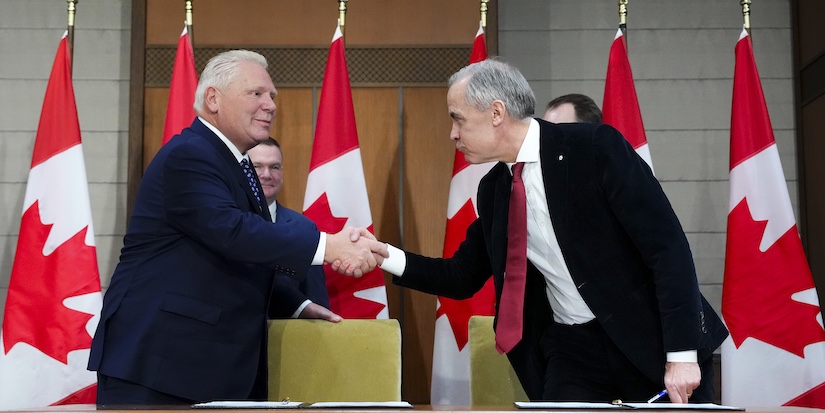
Prime Minister Mark Carney, right, and Ontario Premier Doug Ford shake hands after a signing ceremony on Parliament Hill in Ottawa on Thursday, Dec. 18, 2025. They are joined by Steven MacKinnon, Minister of Transport and Leader of the Government in the House of Commons, back right, and Todd McCarthy, Ontario Minister of the Environment, Conservation and Parks, back left.
THE CANADIAN PRESS/Sean Kilpatrick
Ontario, Ottawa agree to speed up project approvals, including Ring of Fire mining

Published 1:56 PST, Thu December 18, 2025


-

Prime Minister Mark Carney and Ontario Premier Doug Ford signed an agreement Thursday to speed up approval of major projects in the province under a "one project, one process, one decision" model.
This approach means that projects that would have been subject to environmental assessments at both the federal and provincial levels will now go through Ontario's process alone, when the project is located primarily within the province.
"It's time for Canada to build big things again. And nowhere will the impact of this deal be felt more immediately than in the development of the Ring of Fire," Ford told a Thursday press conference in Ottawa.
The Ring of Fire, an area in northern Ontario about 500 kilometres northeast of Thunder Bay, is home to major critical mineral deposits and the provincial and federal governments see it as a major economic driver.
Under the new deal, Carney said projects will use the federal process when Ottawa has primary jurisdiction and a mixed assessment system when they fall under shared jurisdiction. Carney added the federal government retains responsibility for things like preserving fish habitats and migratory bird routes.
"That will make approvals more efficient, delivering major projects faster while maintaining both federal and provincial standards," Carney said.
"By working together, we will work with the same information, we will have the same timelines, and we will respect each other's jurisdictions."
The prime minister said in French the federal government is negotiating similar deals with Manitoba and Prince Edward Island. Carney added he wants to get similar deals in place with every province.
The Ontario agreement also contains language that sets a deadline for the Impact Assessment Agency of Canada to complete its review of roads to planned mining projects in the Ring of Fire region of northern Ontario by June 2026.
Webequie First Nation and Marten Falls First Nation are leading environmental assessments on three roads that would connect the provincial highway system to their communities and mining operations in the mineral-rich Ring of Fire.
While both First Nations say the roads will help lift their fly-in communities out of poverty, other nearby First Nations are not on board with the plan.
Ontario Regional Chief Abram Benedict said in a media statement this agreement weakens the government's constitutional duty to consult with First Nations.
"This agreement prioritizes streamlining approvals while sidelining First Nations’ inherent jurisdiction and weakening the duty to consult. Governments cannot decide when consultation and accommodation are ‘appropriate.' These legal obligations are owed to rights holders from the outset," he said.
"Retaining final decision-making authority without First Nations at the table undermines our rights and treaty relationships. Projects that affect our lands must be built on partnership, not exclusion.”
Benedict has been raising concerns for months about federal and provincial plans to fast-track development.
He called the federal major projects legislation "ludicrous" and said Canadians should be alarmed by government efforts to skirt environmental assessments.
Carney said Ottawa will still honour its constitutional duty to consult with First Nations, "but in a much more effective and efficient way."
Nishnawbe Aski Nation Grand Chief Alvin Fiddler told The Canadian Press Thursday he doesn't see how the agreement signed by Carney and Ford can achieve co-operation when First Nations are excluded.
He said he's written letters to both leaders asking for a meeting to discuss the issues, "because we know that they are looking at the resources — that they want to extract our resources for them to fill up their coffers."
If those discussions don't happen, he said, there will be conflict on the ground.
"We have no issues with streamlining a major projects process, but it shouldn't come at the expense of our rights. That's what our chiefs are standing up for. That's what they're fighting for," he said.
This report by The Canadian Press was first published Dec. 18, 2025.
—With files from Liam Casey and Allison Jones in Toronto.

























2 Hours of free financial consulting
Jai Xin Planning Ltd.
C$120.00 C$0.00

Use any of our home staging service and get a second month rental for free!
MiiX Interiors
C$500.00 C$0.00

Get 10% off any order
Phantom Screens Lower Mainland
C$200.00 C$180.00